Questioning Reb' Lebe about God
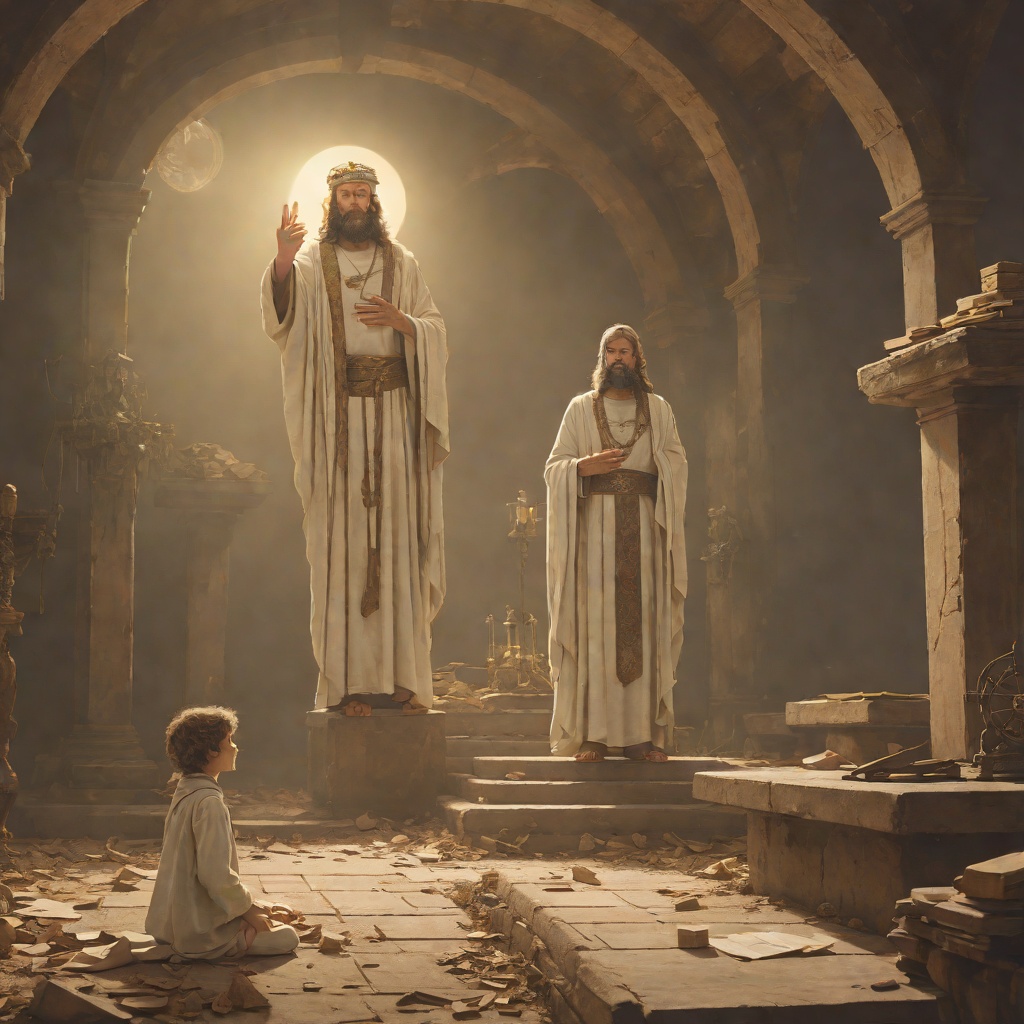
The Captain and Ann BarbaraIn the bare room off the women's gallery of a synagogue in Polotzk, a small girl posed a question that her teacher could not answer. The girl was Mary Antin, and the teacher was Reb' Lebe, the girls' Hebrew instructor. The question—"Who made God?"—was the culmination of a series of inquiries that began with the first verse of Genesis and ended with the collapse of the rebbe's authority. This scene, recalled in Mary Antin's memoir, is a foundational moment in her intellectual and spiritual development, the first clear sign of the restless, questioning mind that would eventually carry her out of the Ghetto and into the public schools and lecture halls of America.
The Setting and the Teacher
The confrontation took place during Mary's Hebrew lessons with Reb' Lebe, a man described as tall and lean, with a lean, pointed face and a thin, pointed beard that had become pointed from much stroking and pulling downwards. His hands were large, his beard was not half a handful, and his fingers were long, with nails that were, Mary feared, not very clean. His coat was rusty, and so was his skull-cap. Reb' Lebe was only a girls' teacher, and nobody would pay much for teaching girls, yet his pupils regarded him with entire respect and followed his pointer with earnest eyes across the limp page of the alphabet or the thumbed page of the prayer-book. Mary and her sister Fetchke had first gone to Reb' Lebe's heder, a noisy place where pupils on the bench shouted their way from aleph to tav, but they soon began to have their lessons in private, at their own home, sitting one on each side of the rebbe, reading the Hebrew sentences turn and turn about.
The Questions and the Rebbe's Defeat
The crisis began when the lessons moved from rote reading to translation, and Mary came to the story of Genesis. She had the great advantage of a complete Yiddish translation, which allowed her to read ahead and know how the stories ended, but it also made her ask questions. The first question came during the lesson itself. The rebbe translated, "In the beginning God created the earth." The pupil repeated the words and then asked, "Rebbe, when was the beginning?" The rebbe, losing his place in amazement, replied, "'S gehert a kasse? (Ever hear such a question?) The beginning was—the beginning—the beginning was in the beginning, of course! Nu! nu! Go on." The pupil resumed, "In the beginning God made the earth.—Rebbe, what did He make it out of?" At this, the rebbe dropped his pointer in astonishment and demanded, "What did—? What sort of a girl is this, that asks questions? Go on, go on!" The lesson continued to the end, the book was closed, and the pointer was put away. The rebbe exchanged his skull-cap for his street cap and was about to go. But the pupil, timidly but determinedly, detained him with the final, unanswerable question: "Reb' Lebe, who made God?" The rebbe regarded her in amazement mixed with anxiety. His emotion was beyond speech. He turned and left the room, and in his perturbation he even forgot to kiss the mezuzah on the doorpost. The pupil felt reproved and yet somehow in the right. Who did make God? But if the rebbe would not tell—would not tell? Or, perhaps, he did not know? The rebbe—?
The Context of a Girl's Education
The significance of this scene is sharpened by the context of female education in the Pale of Settlement. For a girl, it was enough if she could read her prayers in Hebrew and follow the meaning by the Yiddish translation at the bottom of the page. A girl's real schoolroom was her mother's kitchen, where she learned to bake and cook and manage, to knit, sew, and embroider, while her mother instructed her in the laws regulating a pious Jewish household and in the conduct proper for a Jewish wife. A girl was born for no other purpose. Marriage was a sacrament, and to rear a family of children was to serve God. Parenthood was the great career, but while men might busy themselves with the study of the Law, woman's only work was motherhood. Mary's parents, however, had ideals that soared beyond all this. Her mother, although she had not stirred out of Polotzk, readily adopted the notion of a liberal education imported by her father from cities beyond the Pale. Mary and Fetchke were to learn to translate as well as pronounce Hebrew, the same as their brother, and were to study Russian and German and arithmetic. It was within this unusual arrangement that Mary's questions arose, and it was the very fact that she was a girl asking such questions that made the rebbe's defeat so complete. Great scholars would not waste their learning on mere girls, and Reb' Lebe knew enough to teach girls Hebrew, but he did not know enough to answer a girl who asked who made God.
The Birth of an Independent Mind
The scene with Reb' Lebe marks the beginning of Mary's intellectual independence, a quality that would define her American life. She had already shown an extraordinary devotion to her Hebrew reading, chanting the Psalms to the monotonous tune taught by the rebbe, rocking to the rhythm of the chant, reading by the hour though she understood about one word in ten. She loved the sound of the words, the full, dense, solid sound of them. But the questions about Genesis were different; they were not about sound but about meaning, and they could not be answered by the rebbe. The pupil felt reproved and yet somehow in the right, and that sense of being in the right, against the authority of her teacher, was the seed of her later freethought. The narrator of the memoir reflects that she was born, she has lived, and she has been made over, and that she is absolutely other than the person whose story she has to tell. The girl who asked Reb' Lebe who made God was the earlier self, the subject of study, and the question was one of the discriminations in which she emerged as a new being, something that had not been before. She would later declare her freethought in the schoolyard in America, and she would come to love the English language with a passion that she could almost tie to her conviction of immortality. But the first step on that path was taken in the bare room in Polotzk, when a small girl asked her teacher a question he could not answer, and the rebbe turned and left the room, forgetting to kiss the mezuzah on the doorpost.